Posted on 28th July 2026 by Penny Gibbs
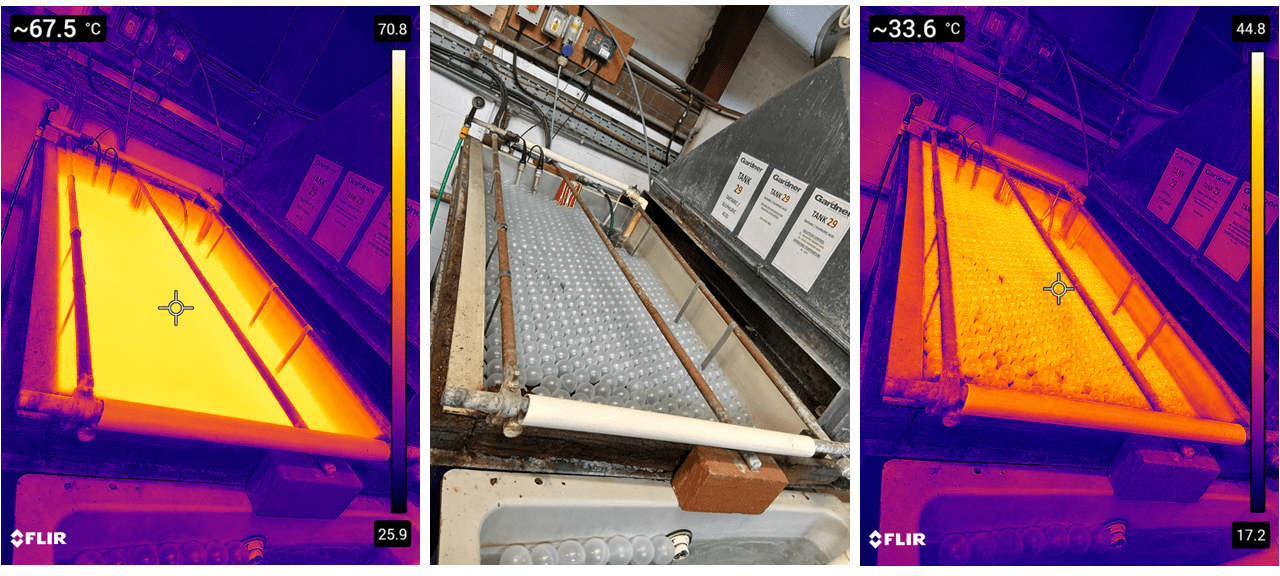
Open process tanks play a vital role in many chemical processing and electroplating plants, but they also create ongoing operational challenges. Heat escapes from the liquid surface, evaporation increases chemical consumption, and vapour can affect both working conditions and operating costs.
While these losses are often accepted as part of the process, simple changes can make a significant difference.
Our latest case study comes from Gardner Aerospace Operations UK Ltd, where our Croffles™ were installed as part of a wider environmental and energy efficiency programme. This example demonstrates how this simple floating cover can improve thermal efficiency, reduce evaporation and support wider sustainability goals without modifying existing plant infrastructure.
Any heated process tank naturally loses energy through three main mechanisms:
Together, these losses force immersion heaters to work harder to maintain process temperatures, increasing energy demand and operating costs. Evaporation also increases the need for makeup water and replacement process chemicals, while raising humidity within the working environment.
To tackle these challenges, Gardner Aerospace Operations installed 50 mm natural polypropylene Croffles™ across three heated chromate treatment tanks.
Unlike rigid covers, Croffles™ form a floating blanket across the liquid surface. They automatically move around pipework, agitation, components entering or leaving the tank, and changing liquid levels without affecting normal operation.
The installation achieved full surface coverage while requiring:
The Croffles™ were simply poured onto the liquid surface, immediately creating an insulating layer across the tanks.
Across the three treatment tanks, Gardner Aerospace recorded:
By covering more than 91% of the exposed liquid surface, Croffles™ reduce direct liquid-to-air contact, limit surface turbulence and create insulating air gaps between each sphere. Together, these factors significantly reduce heat transfer from the tank.
Floating ball covers also support wider sustainability goals by:
For manufacturers operating multiple heated process tanks, these cumulative savings can become significant over time.
Gardner Aerospace’s operational data highlights the potential savings achievable with Croffles™.
The reduction in heating demand equates to approximately 40,500 kWh per year, representing an estimated electricity saving of around £8,100 annually.
Reduced evaporation could also save approximately 85,000 litres per year in makeup water, acid correction, handling and waste, with estimated savings between £4,000 and £17,000 per year, depending on site conditions.
Additional savings may also be achieved through reduced fume extraction requirements following appropriate COSHH and LEV assessments.
Against an approximate Croffles™ investment of £800, the project suggests operational payback could realistically be achieved within weeks rather than months.
As energy costs continue to rise and manufacturers look for practical ways to improve efficiency, floating covers offer a straightforward solution. They deliver measurable operational benefits without disrupting existing processes.
The Gardner Aerospace case study demonstrates how Croffles™ can help reduce heat loss, evaporation, chemical consumption and energy demand while supporting wider sustainability objectives.
If your facility operates heated process tanks, Croffles™ offer a practical way to improve efficiency and reduce operating costs.